


The SaaS Metrics That Predict Growth, and the Ones That Mislead
Table of Contents
Ask ten software executives how their company is performing and you will get ten dashboards. Most will hold more than thirty numbers. Very few will hold an answer. Fewer still reflect a deliberate decision about which SaaS metrics to track.
This is the central problem with SaaS metrics as they are practiced today. The discipline has matured to the point where almost every operator can recite the formulas, and almost none can say which of the figures on the screen actually changed the decision they made last quarter. Measurement has become a substitute for judgment rather than an input to it, and the roster of SaaS KPIs has grown while the clarity has not.
The evidence suggests a different approach. Signal in a subscription business concentrates in a small number of places. Most reported SaaS KPIs are either downstream of those few numbers or, more troubling, are calculated in a way that makes them quietly wrong. Understanding which SaaS metrics predict growth, and which merely describe it after the fact, is the difference between a board deck and a decision.
Measurement has outpaced understanding
The question of which SaaS metrics to track has been answered, at most companies, by accumulation rather than by choice.
The proliferation is easy to explain. Modern billing and analytics tooling made every metric cheap to produce, and cheap production removed the discipline that scarcity used to impose. When a SaaS KPI costs nothing to generate, nobody asks whether it earns its place.
The cost is not the reporting overhead. It is attention. A leadership team that reviews thirty SaaS KPIs each month will treat all thirty as roughly equal, because the format implies equivalence. The genuinely diagnostic SaaS KPIs get the same three minutes as the decorative ones, and the meeting ends without anyone having changed their mind.
A better standard for deciding which SaaS metrics to track is simple. A number belongs on the page only if a plausible reading of it would cause you to do something different. Everything else is history, and history belongs in an appendix rather than on the list of SaaS metrics to track.
The four SaaS metrics that carry most of the signal
Four figures do most of the predictive work in a subscription business. They are not the only SaaS KPIs worth knowing, but they are the SaaS KPIs that tell you whether the model works before the income statement does. If you are rebuilding your reporting from scratch, these are the SaaS metrics to track first.
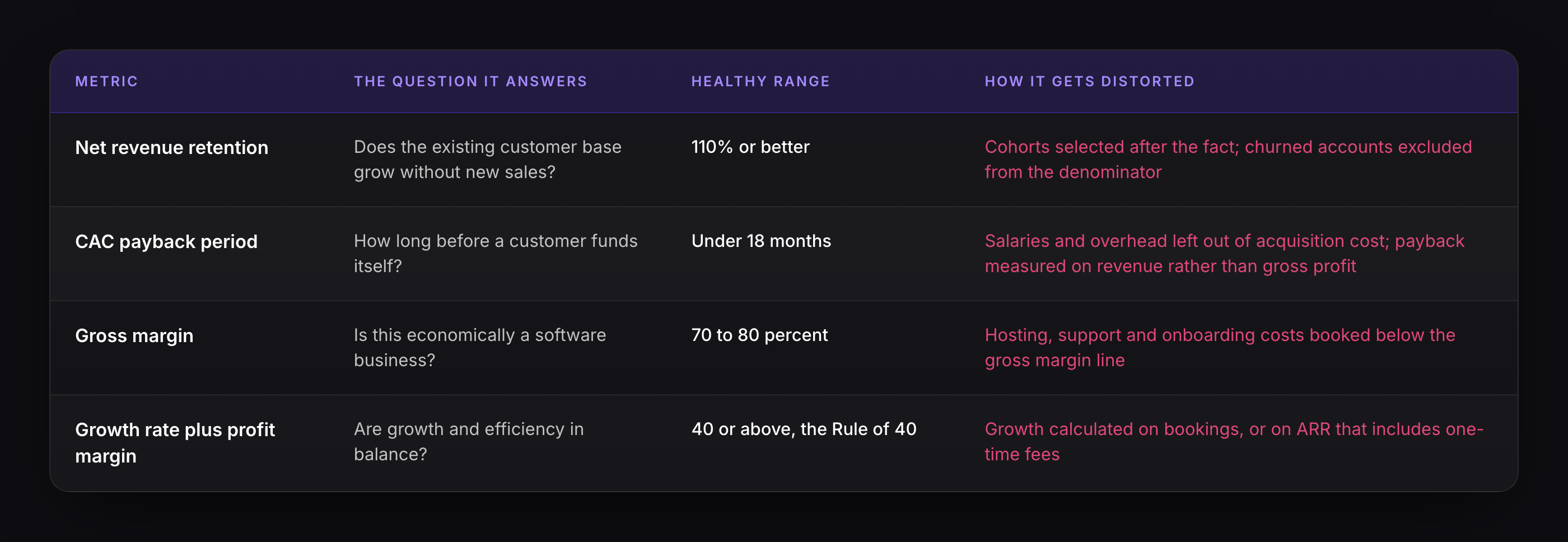
Net revenue retention deserves the top position. It measures what last year's customers pay you this year after upgrades, downgrades, and cancellations, which makes it the only one of the common SaaS KPIs that captures whether the product compounds. Below 100 percent, every dollar of growth must be sold from scratch. Above 120 percent, the business grows even if sales stops entirely for a quarter. Recent benchmarking puts the median closer to 101 percent than to the 120 percent figure that circulated during the last funding cycle, which is worth remembering before you conclude your own SaaS KPIs are disappointing.
CAC payback has quietly become the more urgent of the two efficiency SaaS KPIs. As capital grew more expensive, the tolerable payback window stopped being a theoretical question. Medians have stretched toward eighteen months across much of the industry. A company at thirty months is not inefficient in the abstract, it is dependent on outside funding in a specific and dateable way.
Gross margin functions as a check on the other three SaaS metrics to track. Software economics assume that serving the next customer costs almost nothing. When inference, storage, or human onboarding erode that assumption, the entire framework of SaaS metrics built on top of it starts producing flattering numbers about a business that is not actually a software business.
The SaaS metrics that mislead
The second category is more dangerous. The five SaaS KPIs below appear on almost every dashboard, and they are not wrong so much as routinely over-read.
Monthly recurring revenue. MRR is the most cited of all SaaS metrics and the most frequently contaminated of the SaaS KPIs in common use. The recurring qualifier is doing real work: implementation fees, professional services, and one-time overages are not recurring, and including them inflates every downstream figure that uses MRR as an input. That includes ARR, LTV, and the growth half of the Rule of 40, which is to say most of the SaaS metrics to track downstream of it.
Logo churn. Counting departed customers rather than departed revenue produces a comfortable number in businesses where small accounts leave and large ones stay. It produces a catastrophic blind spot in the reverse case. These two SaaS KPIs should always be read as a pair, because the gap between them is itself the finding.
Lifetime value. LTV is the most assumption-heavy of the standard SaaS KPIs. It requires a churn rate projected over a period longer than most companies have existed, and small changes in that assumption swing the output enormously. LTV computed from twelve months of data on a five year product is closer to a hypothesis than a measurement. It remains useful as a ratio against acquisition cost, and considerably less useful as an absolute number in a board deck. Running that calculation honestly, with the sensitivity exposed rather than hidden, is what our SaaS LTV calculator is built to do.
Net promoter score. NPS measures stated intent, not behavior, and stated intent correlates weakly with renewal in contractual businesses where the person answering the survey is rarely the person signing the invoice. Among customer-facing SaaS KPIs it is a useful trend line and a poor forecast.
Daily and monthly active users. Engagement SaaS KPIs are the easiest of all SaaS metrics to move without creating any value at all. A notification strategy lifts them. So does a worse product that requires more visits to accomplish the same task.
Good SaaS KPIs go wrong in predictable ways
The most valuable audit a leadership team can run is not adding more SaaS metrics to track. It is checking whether the SaaS KPIs already reported are calculated the way everyone in the room assumes.
Four distortions account for most of the damage, and each one corrupts several SaaS KPIs at once.
Acquisition cost that excludes people. CAC is frequently reported as program spend divided by new customers, omitting the salaries of the sales and marketing teams who did the work. Fully loaded CAC is often two to three times the reported figure, which means every one of the SaaS KPIs built on it, payback period and LTV ratio included, is wrong by the same multiple.
Retention measured on survivors. Net revenue retention calculated across accounts that were present at both the start and the end of the period systematically excludes the customers who left. The resulting number describes the experience of customers who stayed, which is not the question anyone was asking.
Annualized SaaS metrics from short windows. Multiplying one strong month by twelve is not a forecast. It is an assumption about seasonality, sales cycles, and renewal timing presented with more confidence than the underlying data supports.
Blended averages across unlike segments. A single company-wide SaaS KPI spanning self-serve and enterprise, or two geographies with different competitive dynamics, reports a customer who does not exist. Most SaaS KPIs become genuinely diagnostic only once they are segmented, and segmentation should govern which SaaS metrics to track in the first place.
Which SaaS KPIs matter at which stage
The flat list format used by most guides implies that all SaaS metrics carry equal weight at every size. They do not, and the answer to which SaaS metrics to track changes materially with company size.
Before product-market fit, retention is effectively the only question worth asking of your SaaS metrics. Cohort retention curves that flatten rather than decaying to zero are the signal. Efficiency measures are premature, because there is not yet a repeatable motion to be efficient about, so they do not belong among the SaaS metrics to track yet.
In the early scaling phase, roughly one to ten million in ARR, the SaaS metrics to track shift toward acquisition efficiency. CAC payback and the channel-level SaaS KPIs behind it determine how fast the company can safely grow. This is the stage where the cost of each acquisition channel should be understood separately rather than blended, and where organic acquisition starts to change the arithmetic, which is much of what B2B SaaS SEO services are engaged to influence.
At scale, above roughly fifty million in ARR, net revenue retention and gross margin dominate. These are the SaaS metrics to track at scale, because growth at that size comes disproportionately from the installed base, and the market prices the business on the durability of that expansion rather than on new logo velocity.
A leadership team reviewing the same set of SaaS KPIs at each of these three stages is, by definition, looking at the wrong SaaS metrics to track in at least two of them.
These SaaS metrics form a system, not a list
The most consequential limitation of the standard treatment is that it presents these SaaS KPIs as independent readings. They are not. They are a small system with visible causality, and reading your SaaS metrics as a system is what turns reporting into diagnosis.
Consider a pattern involving two of these SaaS metrics. Gross retention is healthy while net revenue retention sits flat. The customers are not leaving, so the product is working. The absence of expansion therefore points at pricing structure rather than at product quality or customer success execution. That is a specific, actionable conclusion, and it is invisible to anyone reading either of those SaaS metrics to track on its own.
A second pattern. CAC payback lengthens while win rates hold steady. Acquisition is not getting worse at converting, it is getting more expensive to reach. That points at channel saturation or competitive bidding, not at sales capability. Neither of those two SaaS KPIs says so alone.
The general principle is that no single one of the SaaS metrics to track supports a conclusion on its own. Pairs and ratios do, which is why the useful SaaS KPIs are almost always relational.
What AI pricing is doing to standard SaaS metrics
Two assumptions underneath the conventional set of SaaS KPIs are weakening at once, and both change which SaaS metrics to track.
The first is that recurring revenue is stable and predictable. Usage-based and outcome-based pricing make revenue genuinely variable, which strains MRR as a concept. A company billing on consumption has SaaS metrics that reflect customer activity rather than contracted commitment, and treating the two as equivalent overstates predictability.
The second is that customer headcount proxies for value. Seat-based retention, still among the most common SaaS metrics to track, falls when a customer replaces five coordinators with one operator and an agent, even though the product is delivering more value than before. The SaaS KPIs report contraction. The relationship is expanding. Any company pricing per seat should be reading NRR alongside a usage or outcome measure, or it will mistake a pricing problem for a retention problem.
Neither shift invalidates the standard SaaS metrics, and neither retires the established SaaS KPIs. Both require that the assumptions inside your SaaS metrics be stated rather than inherited.
Start with subtraction
The instinct when SaaS metrics are not producing clarity is to add more of them. The evidence points the other way.
A more productive exercise takes an afternoon. Take your current reporting pack and ask, for each figure on it, when it last changed a decision. Most executives find the honest answer is a small number of SaaS KPIs, usually three or four, and that those few are the SaaS metrics to track that already tell them what they needed to know. Then check how the surviving SaaS KPIs are calculated, because the most common problem is not choosing the wrong SaaS metrics to track but building the right ones on a definition nobody has examined in two years.
If that exercise points at acquisition rather than retention or pricing, the next question is what demand is actually worth against your current unit economics, which is what our SEO ROI calculator was built to answer. And if you would rather think it through with people who work on these numbers daily, we are straightforward to reach.
FAQs
What are the 5 most important SaaS metrics?
Most practitioners converge on net revenue retention, customer acquisition cost payback period, gross margin, monthly or annual recurring revenue, and churn. Of those, net revenue retention carries the most predictive weight, because it reveals whether the business compounds without new sales. The other SaaS metrics to track largely explain why that number moved, which is why these five SaaS KPIs are best read together.
What is the difference between SaaS metrics and SaaS KPIs?
A metric is any measurement of business activity. SaaS KPIs are the subset a company has designated as indicators of whether it is meeting a specific objective, with a target attached. Every one of your SaaS KPIs is a metric. Most SaaS metrics are not SaaS KPIs, and treating them as though they were is what produces thirty-line dashboards nobody acts on.
What is a good net revenue retention rate?
Above 100 percent means the existing base grows on its own. Recent benchmarks place the median near 101 percent, with strong performers above 110 percent and best-in-class businesses above 120 percent. Read it alongside gross retention, since healthy headline SaaS metrics can conceal meaningful logo churn offset by expansion within a few large accounts.
What SaaS metrics do investors care about most?
Growth rate, net revenue retention, gross margin, and CAC payback, usually assessed together through the Rule of 40. Investors also scrutinize how those SaaS metrics are constructed, since the most common diligence finding is not weak performance but SaaS KPIs calculated on favorable definitions.
How often should you review your SaaS metrics?
Pipeline and acquisition SaaS KPIs reward weekly attention. Retention, margin, and efficiency measures move too slowly for that and are better reviewed monthly, with cohort analysis quarterly. Reviewing slow-moving SaaS metrics weekly generates noise that invites overreaction to normal variance, so let the cadence follow the metric.