

SaaS Subscription Models Explained: 8 Structures, Compared Side by Side
Table of Contents
Most software companies spend nine months building a product and about nine minutes choosing how to charge for it. Then they spend three years discovering that the charging decision mattered more. Your packaging decides who can afford to try you, how fast accounts expand, whether sales can close without discounting, and what an acquirer will pay for the company. Choosing between SaaS subscription models is not a billing task. Your SaaS pricing strategy is the highest-leverage product decision most founders make on instinct.
This guide compares all eight SaaS subscription models side by side, explains the SaaS pricing strategy behind each one, shows the signals that tell you your current structure is wrong, and walks through changing structures without detonating your existing base.
What SaaS subscription models actually are
SaaS subscription models are the recurring structures that turn product usage into revenue, the rules for what you meter, how often you bill, and what triggers a larger invoice. Every one of them sits on top of a value metric: the single unit a customer buys more of as they succeed. A seat. A contact record. An API call. A closed deal.
Three ideas get used interchangeably here, and separating them is worth a minute. The model is the structure itself: per-seat, usage-based, tiered. The price is the number attached to it. The SaaS pricing strategy is the reasoning that connects both to the market you are attacking: who you target, what you meter, where you sit against competitors, and how accounts are meant to grow. Teams that jump straight to the number end up defending a well-researched price sitting on a broken structure. No SaaS pricing strategy survives being wrong about the value metric underneath it.
How SaaS subscription models differ from software licensing
The older way to buy software was a perpetual licence: one large payment up front, ownership forever, and a separate annual fee for maintenance and support. SaaS subscription models replaced that with continuous access, the vendor hosts the software, absorbs infrastructure and updates, and bills on a cycle instead of an event.
The consequence most teams underrate is where the risk moved. Under a licence, the buyer carried the risk after signing. Under a subscription, the vendor carries it every single month, because the customer can leave. That is why retention sits at the centre of every serious SaaS pricing strategy, and why SaaS subscription models are judged on expansion rather than on deal size.
The 8 SaaS subscription models, compared
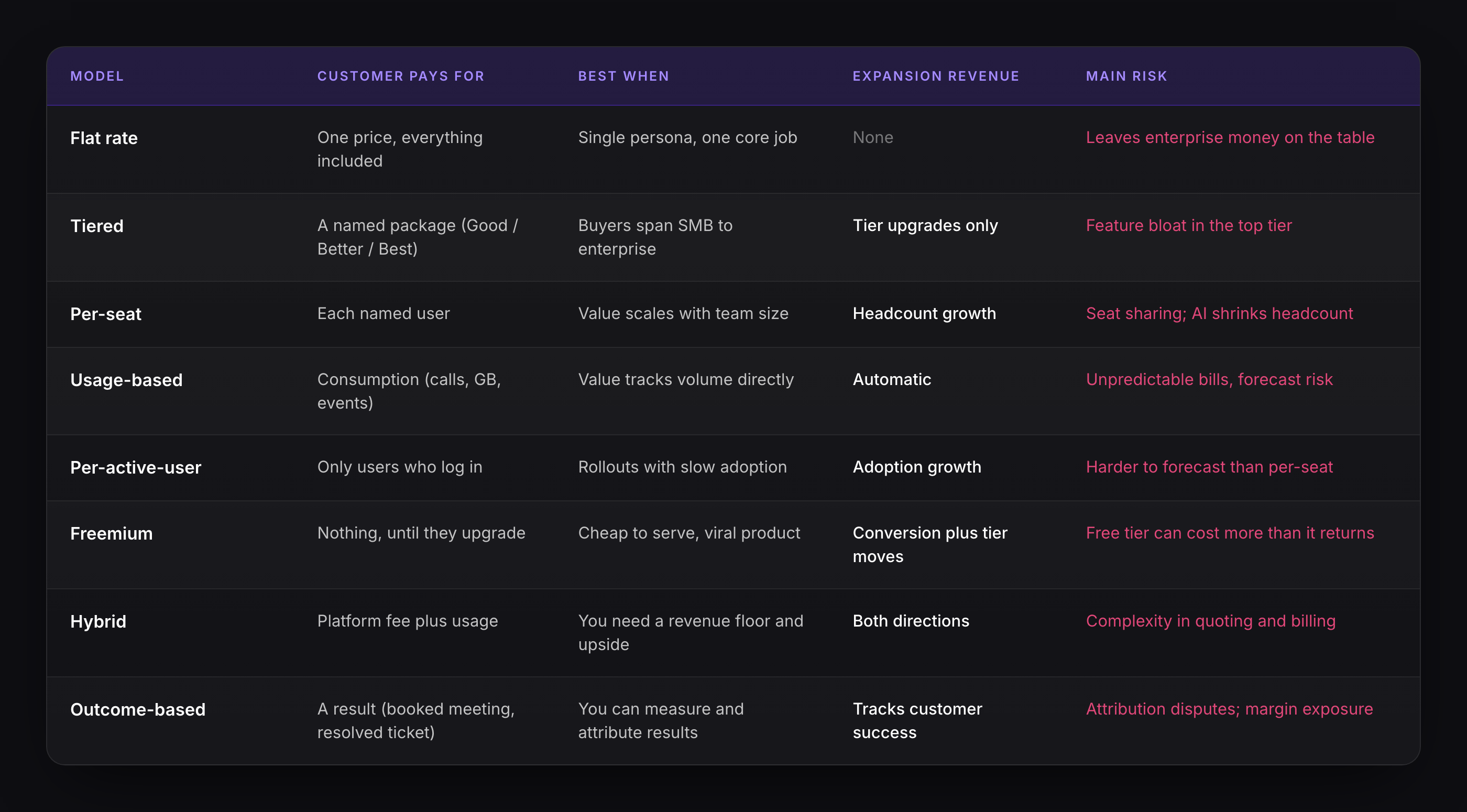
The table below is the fastest way to narrow the eight SaaS subscription models down to two. Every one of these SaaS pricing models is running today inside companies above $100M ARR, so none is inherently wrong, each is wrong only relative to a specific buyer and a specific cost structure.
1. Flat rate
One price, one package. Flat rate is the easiest of the SaaS subscription models to sell and the hardest to grow on, because a customer extracting ten times the value pays exactly what everyone else pays. Treat it as a beachhead structure, win the segment, then graduate to one of the SaaS pricing models that has expansion built in. As a starting SaaS pricing strategy it is hard to beat; as a permanent one it caps you.
2. Tiered
Three or four named packages remains the default across SaaS pricing models, and deservedly so: one page can speak to a solo operator and a procurement committee at once. The discipline that separates good tiered SaaS subscription models from bad ones is deciding what gates each tier, a feature, a usage limit, or a support level. Then defending those gates against every sales exception request.
3. Per-seat
Per-seat remains the most recognized of all SaaS pricing models, and it built the modern software industry. It is legible, forecastable, and trivial to procure. It also carries the category's most exposed assumption: that customer headcount keeps rising. When a customer replaces five coordinators with one operator and an agent, per-seat revenue falls while delivered value climbs.
4. Usage-based
Among consumption-led SaaS subscription models, the rule is simple: charge for what gets consumed. Usage-based structures align cost with value better than any alternative and expand without a renewal conversation, which is why they dominate infrastructure. The tradeoff is variance. Finance teams dislike bills they cannot predict, and so will yours. Of all the SaaS pricing models here, this one demands the most mature forecasting.
5. Per-active-user
A softer per-seat, and one of the most underused SaaS subscription models. The customer provisions everyone and pays only for people who actually log in, which removes the deployment risk that stalls large rollouts. Among SaaS pricing models aimed at enterprise rollouts, this is the easiest one to start.
6. Freemium
In freemium SaaS subscription models, the free tier is a distribution channel, not a price. It works when marginal cost per free user rounds to zero and the product generates its own exposure. It fails quietly when support and infrastructure for non-payers outgrow the revenue those users eventually produce, which is why freemium is the riskiest of the SaaS subscription models to run without a conversion benchmark.
7. Hybrid
A platform fee plus metered consumption. Hybrid has become the consensus answer among modern SaaS pricing models because it delivers a predictable floor and uncapped upside simultaneously. Of all the SaaS subscription models here, it is the one most companies drift toward after outgrowing per-seat.
8. Outcome-based
You charge for a result rather than for access, per resolved ticket, per qualified lead, per completed workflow. This is the newest entry among SaaS subscription models and the one AI products are pushing hardest. As a SaaS pricing strategy it is the most persuasive pitch in any room and the most operationally demanding structure to run, because every invoice depends on attribution both sides accept.
How to choose your SaaS pricing strategy: four questions
A sound SaaS pricing strategy falls out of four answers, taken in this order.
1. What grows when the customer succeeds? Seats, records, volume, or outcomes, whatever that is, meter it. Nearly every failed SaaS pricing strategy is a mismatch at this step. A company charging per seat while its customers derive value from data volume will watch usage climb for years while revenue sits flat.
2. Who signs the contract? A credit card and a procurement committee want opposite things. Self-serve buyers need a visible number and an instant start. Enterprise buyers need annual commitments, predictability, and a contract. A SaaS pricing strategy that ignores one of the two leaves a whole segment unsold. Serving both usually means published tiers at the bottom of the range and a custom quote at the top — which is why so many SaaS subscription models are really two models stacked.
3. How exposed is your gross margin? If serving a customer costs materially more as they use more: inference, storage, egress. A flat structure eventually inverts your margin. That single constraint eliminates several of the eight options before preference enters your SaaS pricing strategy at all.
4. What do buyers already understand? Being the only vendor in your category with a novel meter means paying an education tax on every deal. A differentiated SaaS pricing strategy is sometimes worth that tax. More often it is not, and the safer play is one of the familiar SaaS subscription models priced unusually well.
The signal that your SaaS pricing strategy is broken
Net revenue retention is the tell. It measures what last year's cohort pays you this year, after upgrades, downgrades, and churn — which makes it the cleanest read on whether your chosen SaaS subscription models have growth built into them.
Below 100%, it does not, and every dollar of new revenue must be sold from scratch. Between 100% and 110%, your SaaS pricing strategy works but is not pulling its weight. Above 120%, the model expands on its own and your SaaS pricing strategy is doing real work.
Read it against two other numbers. If gross retention is healthy while net retention stays flat, customers love the product and your model has no mechanism to charge for that love, a value metric problem, not a price problem, and the most common failure across all SaaS pricing models. If CAC payback stretches past 18 months, your entry point is probably too low or too heavily discounted. Our SaaS LTV calculator exists to run exactly those unit economics against whichever of the SaaS subscription models you are running today.
Changing structures without losing your base
Migrations between SaaS subscription models fail on communication, not on math. Every SaaS pricing strategy is a promise, and promises are broken in the telling. A repricing that keeps existing customers whole and gives them a reason to move will survive. One that arrives as a surprise invoice will not.
Four rules hold up across most transitions:
- Grandfather existing accounts on current terms for a full renewal cycle.
- Model the change against twelve months of real usage data before announcing anything, so you know precisely who receives a larger bill.
- Give notice in months, not weeks, especially when moving between SaaS pricing models with different bill shapes.
- Make the new structure the better deal for your best customers. If your happiest accounts pay more with nothing added, you have a tax, not a SaaS pricing strategy.
Run the new SaaS pricing strategy on new logos first. Three months of live pricing data from real prospects will teach you more than any spreadsheet comparing SaaS pricing models in the abstract.
Where SaaS pricing models are heading
The per-seat assumption is under genuine pressure. When software replaces work rather than assisting with it, headcount stops being a proxy for value and a model that bills by headcount starts shrinking as the product improves. That is why so many companies are shifting toward hybrid and outcome-based SaaS subscription models: they bill for work delivered rather than people employed.
None of this makes per-seat obsolete, and it remains one of the cleanest SaaS pricing models on the market. Plenty of collaboration products still scale cleanly with team size. But the default is no longer automatic, and any SaaS pricing strategy resting on the assumption that customer headcount only rises now deserves an explicit defense.
The second shift reshaping SaaS pricing strategy is discovery. Buyers increasingly compare SaaS pricing models through AI assistants that read your pricing page and summarize it against three competitors in a single answer — which means unclear packaging now costs you deals you never knew you were in. Structured, crawlable, genuinely legible pricing pages have become an acquisition channel, and that is a large part of what modern B2B SaaS SEO services actually optimize for.
Four mistakes that break a SaaS pricing strategy
Charging for the wrong unit. All SaaS pricing models rest on a meter. If the meter does not move when the customer wins, no amount of price optimization will rescue the structure. This is the root cause behind most underperforming SaaS pricing models.
Adding tiers instead of fixing the metric. Tiers are the cheapest lever in any SaaS pricing strategy and the least effective one. A fourth and fifth package usually hides a value metric problem rather than solving it, and each new tier makes the page harder to read.
Discounting the structure, not the price. Handing an enterprise buyer unlimited seats to close a quarter does not discount the deal, it permanently removes that account from your SaaS subscription models and makes the next renewal a negotiation from zero.
Never revisiting it. A SaaS pricing strategy set at $500K ARR and left untouched at $10M is not a strategy any more. It is an artifact, and it is quietly repricing you against newer SaaS pricing models every quarter.
Start with the number, not the structure
There is no universally correct answer here, only a structure that matches what your customers actually buy more of when they succeed. All eight SaaS subscription models above work somewhere, and every one of the SaaS pricing models listed is defensible in the right market. Your job is to find the assumption your SaaS pricing strategy quietly depends on, and check whether it is still true.
If you want a concrete place to start, pull your net revenue retention and CAC payback for the last four quarters. Read against the eight SaaS subscription models above, those two numbers will tell you within an afternoon whether you have a pricing problem, a positioning problem, or an acquisition problem, and each points at a very different fix.
When the answer turns out to be acquisition, our SEO ROI calculator shows what organic demand is worth against your current plan economics. And if you would rather think it through out loud with people who work on this daily, we are easy to reach.
FAQs
What is the most common SaaS subscription model?
Tiered pricing is the most widely used of the SaaS pricing models — typically three or four named packages plus a custom enterprise option. It stays popular because a single pricing page can serve a solo user and a procurement committee. Among newer companies, hybrid SaaS pricing models combining a platform fee with metered usage are gaining ground fastest.
How do SaaS subscriptions actually work?
The customer pays a recurring fee, usually monthly or annually, for hosted access to software including updates, infrastructure, and support. Billing renews automatically until cancelled, and most SaaS subscription models let plans be upgraded or downgraded mid-cycle with prorated charges. Annual plans across most SaaS pricing models carry a 15–20% discount, because prepayment improves cash flow and measurably reduces churn.
What is the difference between SaaS pricing models and SaaS pricing strategy?
SaaS pricing models are the structures — per-seat, usage-based, tiered, hybrid. A SaaS pricing strategy is the reasoning that selects one of those SaaS subscription models: your target segment, your value metric, your competitive position, and your intended expansion path. Two companies can run identical SaaS subscription models under completely different strategies and get opposite results.
Which subscription model is best for a SaaS startup?
Early on, pick the one of the SaaS subscription models a buyer understands in ten seconds — usually flat rate or a simple two-tier structure. Complexity is something you earn once you have enough customers to see where value actually concentrates. Most companies then migrate to tiered or hybrid SaaS subscription models somewhere between $1M and $5M ARR.
How often should you change your SaaS pricing?
Review your SaaS pricing strategy at least annually and after any significant product expansion — the model can stay, but the numbers should not sit still. Most companies under-reprice rather than over-reprice: they ship years of new capability without adjusting, quietly subsidizing their largest accounts. Structural changes between SaaS subscription models should be rare, carefully modeled, and announced months ahead. Price changes inside one of the SaaS pricing models you already run are far safer.