

API Pricing Models Explained: 8 Structures, 9 Real Examples, One Way to Choose
Table of Contents
Eight API pricing models are in commercial use: flat-rate, pay-per-call, tiered packages, subscription plus metered overage, prepaid credits, freemium, revenue-share, and outcome-based. Choosing among them comes down to a single decision, which is the unit you bill for. Everything after that is packaging.
Most treatments stop at the list. This one runs a single customer through all eight API pricing models on identical numbers, so the eight invoices sit side by side, then builds the cost of serving one call from the bottom up, because a price you cannot serve profitably is not an API pricing strategy. Nine real API pricing examples and a four-question test follow.
What are API Pricing Models?
An API pricing model turns API usage into revenue. It specifies the unit you charge for, the commitment you ask up front, and how you bill consumption above it.
All eight API pricing models share three layers, and most API pricing strategy arguments turn out to be disagreements about which layer is broken.
- The billing unit. A call, a token, a document, a successful outcome, or a percentage of transaction value. This is the decision that matters most.
- The commitment. Nothing, a monthly minimum, an annual contract, or a prepaid balance.
- The enforcement. Rate limits, quotas, and hard or soft caps. Without this layer, the first two are only suggestions.
Section five sets out nine API pricing examples with all three layers visible.
One boundary is worth drawing first. This article is about billing machine consumption. For pricing a product that humans log into, the seat-based structures are covered in our guide to SaaS subscription models. The names overlap, since both worlds have tiered, freemium and usage-based plans, but API pricing models meter at the request, which changes every mechanic below.
The 8 API Pricing Models, Compared Side by Side
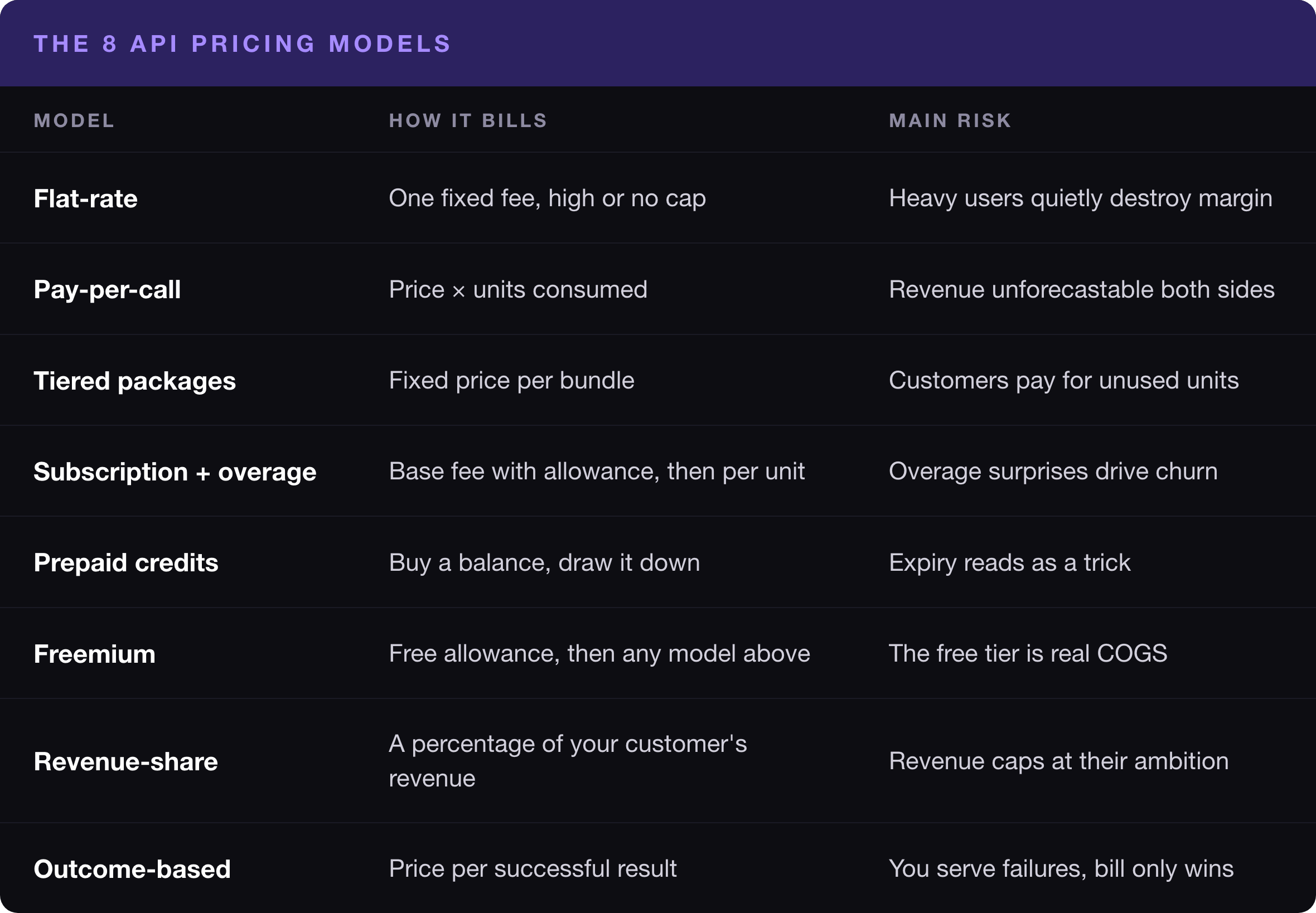
The eight structures and the risk each carries. Real API pricing examples for each appear in section five.
1. Flat-Rate
One price, one invoice, and no meter the customer thinks about. It sells easily, and it is the easiest of the API pricing models to underwrite badly. Your top decile of accounts can consume twenty times the median, and flat-rate hides that until someone reads gross margin per account.
2. Pay-Per-Call
Price multiplied by units. Margin holds at every volume, which is why a per-call API pricing strategy is the default across infrastructure. The cost is forecastability. Finance dislikes a line item that can triple without a purchase order, and procurement often will not sign one.
3. Tiered Packages
Bundles sold at fixed prices: 250,000 calls for $2,900, or 750,000 for $5,400. Buyers get a budget line, you get predictable revenue, and the gap between tiers does the selling. A tiered API pricing strategy is paid for by the customers who sit just above a boundary and buy a tier they half use.
4. Subscription Plus Metered Coverage
A base fee covering an allowance, then a per-unit rate above it. Most public APIs land here once the customer base is mixed, because it produces a revenue floor while leaving upside attached to usage. It is also the hardest of the API pricing models to communicate, which is why overage design gets its own section below.
5. Prepaid Credits
The customer buys a balance and draws it down, and one call costs one credit or forty depending on the endpoint. A credit-based API pricing strategy handles spiky usage and reprices single endpoints without reissuing contracts. Breakage, meaning unused credits at expiry, is real revenue, and buyers know it, so a short expiry window reads as adversarial.
6. Freemium
A free allowance that removes the signup decision, then one of the models above. It is the standard adoption play and the only one of these API pricing models carrying an unbilled cost of goods, which almost nobody quantifies. Treat the free tier as customer acquisition cost, put it in the CAC numerator, and it stops being invisible.
7. Revenue-Share
You take a percentage of what your customer charges their own users. A revenue-share API pricing strategy aligns you with a partner's success and caps you at their pricing ambition. It is common where the API is embedded and invisible to the end user.
8. Outcome-Based
You bill per result, such as a resolved ticket or a validated document, rather than per attempt. It is the newest of the API pricing models and the one buyers are pushing for on AI products. It moves execution risk onto you, because you pay compute on every failure and invoice only the successes, which makes accuracy a margin lever rather than a quality metric. Intercom's Fin is the clearest of the API pricing examples below.
One API, Eight Invoices: All Eight API Pricing Models on The Same Numbers
Comparisons of API pricing models rarely get this far. One customer, one volume, eight structures.
The setup. A document-parsing API. The customer is a mid-market logistics company running 400,000 calls in a normal month and 620,000 at peak. Serving a call costs us $0.0021, built up in the next section. Each model is priced to land near $4,000 a month at normal volume, so that the comparison isolates structure rather than price level.
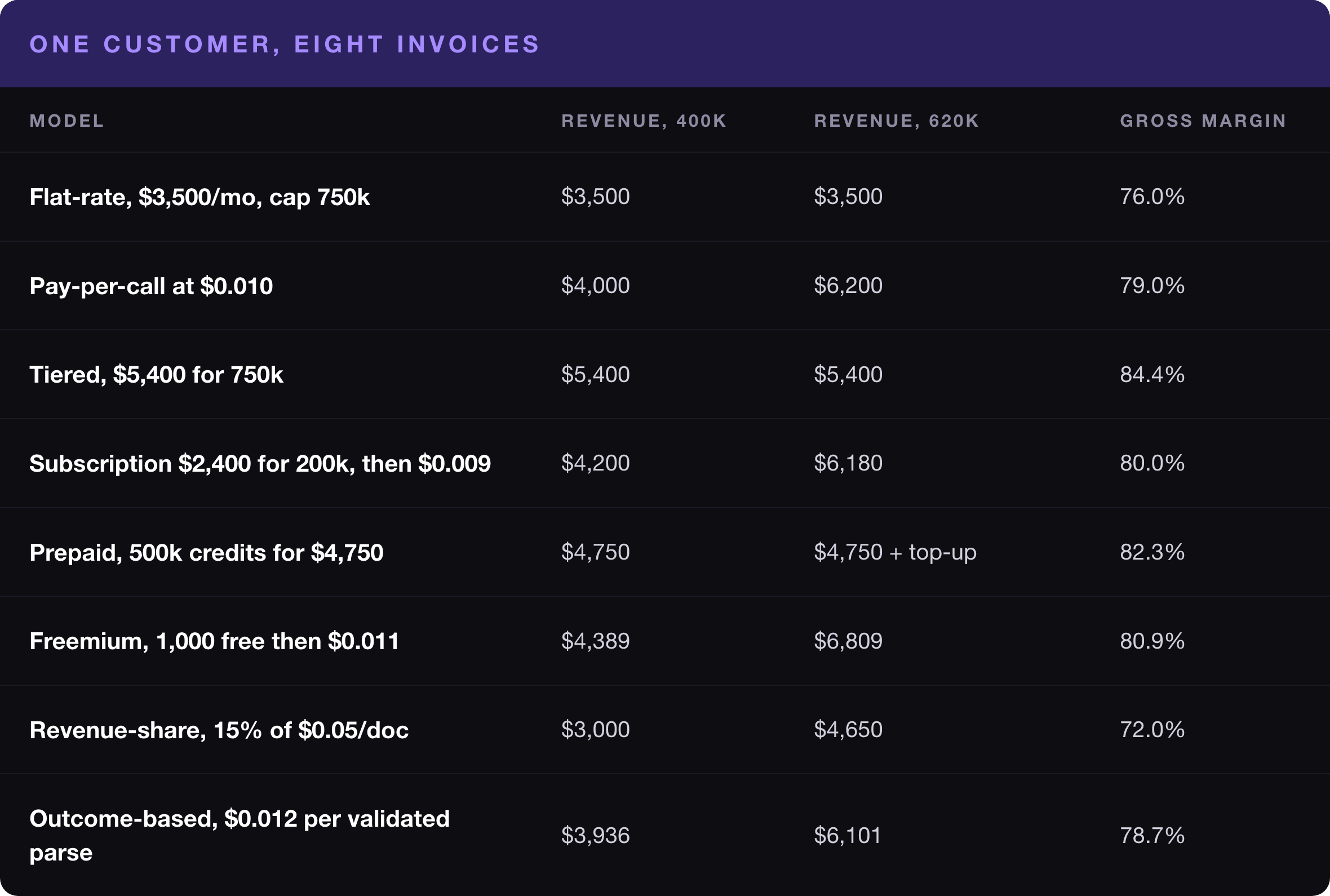
Every figure is reproducible. Pay-per-call is 400,000 × $0.010. The hybrid is $2,400 + (200,000 × $0.009). Outcome-based is 400,000 × 0.82 × $0.012. Gross margin is revenue minus 400,000 × $0.0021, divided by revenue. Substitute your own volume and cost, and the shape of all eight API pricing models holds.
The table makes three points that are hard to see in prose.
The spread between the cheapest and dearest structure is 80%. Same customer, same usage, same value delivered, and the invoice ranges from $3,000 to $5,400 on structure alone. That settles any suggestion that the choice among API pricing models is second-order.
Structure decides who carries volume risk. At peak, flat-rate and tiered absorb 220,000 extra calls for nothing, so you take $462 of cost and bill zero. Pay-per-call, freemium and outcome-based pass the whole increase through, and the hybrid splits it. Choosing an API pricing strategy is a decision about whose forecast has to be right.
Outcome-based pricing costs you the failures. The customer sends 400,000 documents and 328,000 clear validation. You pay compute on all 400,000 and invoice 328,000. Lift the pass rate to 90% and revenue rises 10% with no price change and no new customers, which is why outcome pricing converts accuracy work into a margin project. The API pricing examples below show the same effect at scale.
What a Call Costs to Serve: The Margin Floor Under Every API Pricing Strategy
None of the pages ranking for this term computes this number, and it is the one that should set your price. The $0.0021 used above, built up:
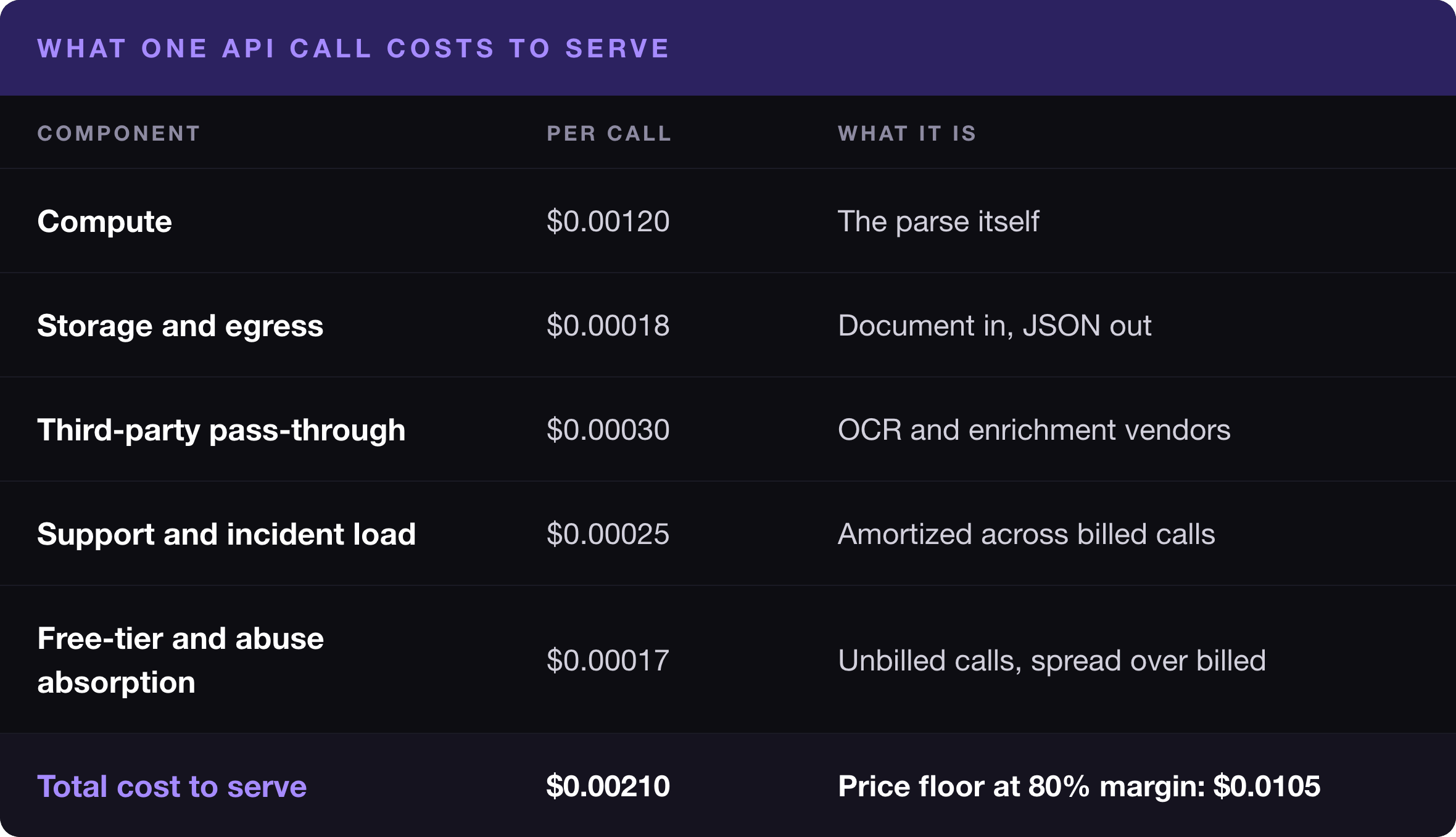
The last row is a floor. For any target margin, the minimum price per unit is cost divided by one minus the target.
Price floor = $0.00210 ÷ (1 − 0.80) = $0.0105 per call
At 80% gross margin, which is the level software investors treat as normal and the reference point we use in the SaaS metrics that predict growth, you cannot charge less than 1.05 cents a call. All eight API pricing models in the table above clear that floor, and so do the nine API pricing examples in the next section. That is the reason those prices are what they are.
Now swap the model behind the API. Replace the parse with a reasoning model on a long document, and compute rises from $0.00120 to $0.0180. Nothing else changes.
New cost to serve = $0.0180 + $0.00018 + $0.00030 + $0.00025 + $0.00017 = $0.0189
Price floor at 80% margin = $0.0189 ÷ 0.20 = $0.0945 per call
The floor has moved by a factor of nine. The flat-rate customer from the earlier table, paying $3,500 a month for 400,000 calls, now costs $7,560 a month to serve, putting gross margin on that account at −116%. No API pricing strategy survives that, and the remedy is the metering rather than the rate.
Our position is this. When the billing unit and the cost unit diverge, meter the cost unit and package the value unit. Bill tokens, calls or documents, because that is what you pay for, and describe the plan in resolutions or reports, because that is what the buyer understands. Any API pricing strategy charging a fixed fee for a variable-cost AI workload is one model upgrade from negative gross margin.
9 Real API Pricing Examples, and What Each One Gets Right
These nine API pricing examples are here because each settles a different API pricing strategy question. Figures are as published in September 2026 and will drift, while the structures are the durable part. The nine API pricing examples at a glance:
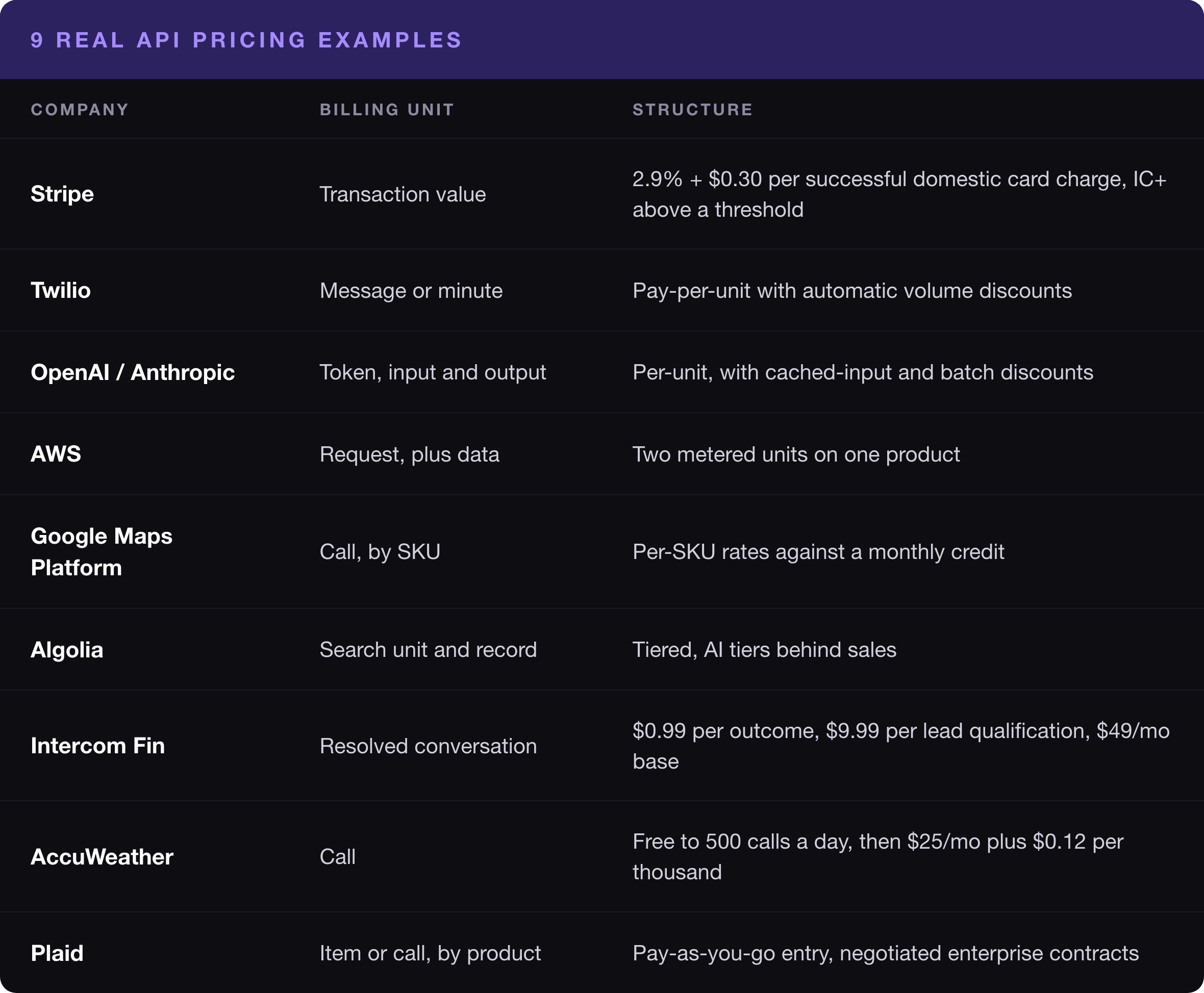
What to take from these API pricing examples:
Stripe prices the customer's revenue rather than its own cost
The most copied of these API pricing examples works because payment value correlates with payment risk, Stripe's real cost driver. Revenue grows with the customer, with no renegotiation and no meter the developer has to reason about. Copy it only if your cost scales with the same thing. Twilio is the same idea at a simpler unit: one rate card, automatic volume discounts, no tier boundary to argue about.
The token APIs split the unit in two
Charging input and output separately is the cleanest case of metering the cost unit, since output costs more to generate and so costs more to buy. Cached-input and batch discounts then price the cost structure, not the volume.
Intercom priced the outcome and then had to define it
The interesting part is not the $0.99. It is that Intercom had to write down what counts as a resolution, publish it, and defend it at invoice time. Every outcome-based API pricing strategy inherits that obligation.
AccuWeather treats freemium as qualification
Among freemium API pricing examples it is the best calibrated: 500 calls a day builds a prototype and will not run a business, so the free tier answers whether the API works and nothing more.
Algolia gates capability rather than volume
The last of these API pricing examples puts AI features behind a sales tier, turning the pricing page into a lead form for exactly the accounts worth a conversation. It is the cleanest way to run high-touch and self-serve on one product.
How to Choose: The Four Questions That Settle Your API Pricing Strategy
Four questions, taken in order. Each eliminates some of the API pricing models, and the API pricing examples above show every answer in production.
1. What does one unit of value look like to the buyer?
Not to you. Customers think in documents parsed, conversations resolved and verifications completed, not in tokens or requests. Write that unit down, because it is your packaging unit.
2. Does your cost scale with that unit?
If it does, price the unit directly through pay-per-call, per-unit or outcome-based billing. If cost is flat while usage varies widely, flat-rate and tiered become defensible. If the two diverge, meter the cost unit and describe the value unit.
3. Can the buyer forecast their own bill?
If not, pure consumption pricing loses enterprise deals however fair it is. A base fee with an allowance is not a worse API pricing strategy. It is the version procurement can sign.
4. What happens in the 95th-percentile month?
Run the numbers. If the answer embarrasses you either way, whether a surprise five-figure invoice or a flat-rate account at negative margin, the structure is wrong rather than the price.
Rate Limits, Quotas and Overage: Where an API Pricing Strategy Leaks Money
Plan boundaries exist only if something enforces them, and this is the layer comparison articles skip. Most API pricing models get published without it.
Rate limits are not quotas
A rate limit caps requests per second and protects infrastructure, while a quota caps units per billing period and protects margin. They are separate systems, and confusing them is how accounts consume three tiers' worth of units without hitting a limit.
Choose cap behavior deliberately
A hard cap stops serving at the boundary, which is predictable for you and an outage for the customer. A soft cap serves past it and bills overage, which is better for revenue and the usual source of surprise-invoice churn. A throttle degrades service instead of refusing it, the right default for anything user-facing. Publish which behavior applies to each plan, because most API pricing examples in the wild do not.
Price burst separately from volume
A customer averaging 10 calls a second with 400-call spikes costs you the capacity to serve 400, not 10. If infrastructure is provisioned for peaks, your API pricing models should charge for peaks, through a burst allowance or a committed-throughput SKU.
5 Ways an API Pricing Strategy Breaks
Five failure modes show up across all eight API pricing models. Each one is an API pricing strategy problem rather than a rate problem.
The unit the customer cannot predict
Pricing-page traffic converts badly and sales calls go on cost estimation. The cause is a unit nobody can forecast before integrating. Publish a calculator, or add a base plan so the first invoice is knowable.
The unit that no longer tracks cost
Gross margin falls while revenue rises. The cause is usually a model upgrade that made the workload behind a call dearer with no change to price. Recompute cost to serve quarterly, per endpoint.
The free tier that funds abuse
Free-tier infrastructure cost grows faster than free-to-paid conversion. The cause is no verification, no per-account rate limit, and an allowance generous enough to be a product. Cap it at prototype size and require a payment method.
The tier with no overage
Accounts cluster exactly at plan ceilings and tickets ask for "just a bit more". The cause is no way to bill above the allowance, so expansion needs a manual upgrade that often does not happen. Add metered overage with a customer-set cap. All nine API pricing examples above have a documented path to buy more.
Grandfathering forever
A growing cohort sits on prices you would not offer today, and revenue per call falls year over year. The cause is that every repricing exempted existing customers permanently. Grandfather for a stated term, announced as a term.
How to Change API Pricing Without Breaking Your Customers' Budgets
Any API pricing strategy has to survive its own repricing, and that is harder than repricing a seat, because the number is often written into someone's code, their chargeback model, or their price list. It is also where published API pricing examples stop helping, since companies rarely document how they migrated. Four rules keep an API pricing strategy intact through a change.
Give more notice than feels necessary
Ninety days for self-serve, a full renewal cycle for contracts. Anyone reselling your API downstream must reprice before yours changes.
Never change the unit and the rate together
Moving from per-call to per-token while raising the price is indistinguishable from an arbitrary increase. Change the unit at revenue neutrality, then move price.
Ship the invoice diff
Every affected account gets its last three months recomputed under the new model before it takes effect. Their own numbers end the argument that an abstract explanation starts.
Legacy pricing
Legacy accounts sitting 40% below list are an open-ended discount with nothing attached. Give it a term, and give the customer something for adopting the new API pricing model early.
Your 3-Step Action Plan for This Week
- Calculate your price floor: Compute the fully loaded cost to serve one call per endpoint—factoring in free-tier absorption. Divide that cost by
1 - target marginto establish your baseline floor, then audit every published plan against it. - Audit account-level margins: Run your top ten accounts through their 95th-percentile usage month to evaluate gross margin per account rather than per product.
- Fix cross-subsidization: If heavy users are eroding profit margins, shift to usage metering instead of issuing a blanket price hike.
Whichever framework you choose, a sustainable API pricing strategy comes down to one core rule: your billing unit and your cost unit must point in the same direction.
Ready to Align Your Pricing with Your P&L?
When your pricing page stops reflecting your actual cost structure, we step in to reconcile the math. We work directly with API-first and B2B SaaS teams to build scalable monetization strategies that protect gross margins without burning developer goodwill.
FAQs
What are the main API pricing models?
Eight API pricing models cover commercial practice: flat-rate, pay-per-call, tiered packages, subscription plus metered overage, prepaid credits, freemium, revenue-share and outcome-based. Most public APIs converge on subscription plus overage past early traction, because it produces a revenue floor while keeping upside attached to consumption. The rest vary only in which unit gets metered and when it is paid for. Choose among the eight API pricing models by unit.
What is the difference between an API pricing model and an API pricing strategy?
The model is the mechanism: the unit, the commitment, the billing rule. An API pricing strategy is the set of decisions around it, covering which segments you serve, what you gate behind sales, where discounts are allowed, and what margin you underwrite. Two companies can run identical pay-per-call models with opposite strategies, one buying share at 40% gross margin, the other defending 85%.
Which API pricing model works best for an AI API?
Meter the unit that drives your inference bill, whether tokens or documents processed, and package it in the unit your buyer recognizes. An AI API pricing strategy should avoid flat-rate and long-dated prepaid credits, because a model upgrade can multiply cost per call while the price stays fixed, and the account goes negative without anyone doing anything wrong. Outcome-based pricing works only where the outcome is measurable and you can absorb the failures.
What gross margin should an API business target?
Software investors generally expect 75–85%, and the floor formula gets you there: divide fully loaded cost to serve by one minus the target margin. AI-backed APIs often run 40–60%, because inference is a genuine variable cost rather than a rounding error. That is a viable business, but it has to be a deliberate choice, priced and reported as one.
What are some API pricing examples from well-known companies?
Stripe charges a percentage of transaction value plus a fixed fee; Twilio charges per message with volume discounts; OpenAI and Anthropic charge per input and output token; AWS meters requests and data transfer separately; Google Maps prices per SKU against a monthly credit; Intercom's Fin charges $0.99 per resolved conversation. Those API pricing examples cover four billing units: value, volume, consumption and outcome. Section five has all nine with the trade-offs.